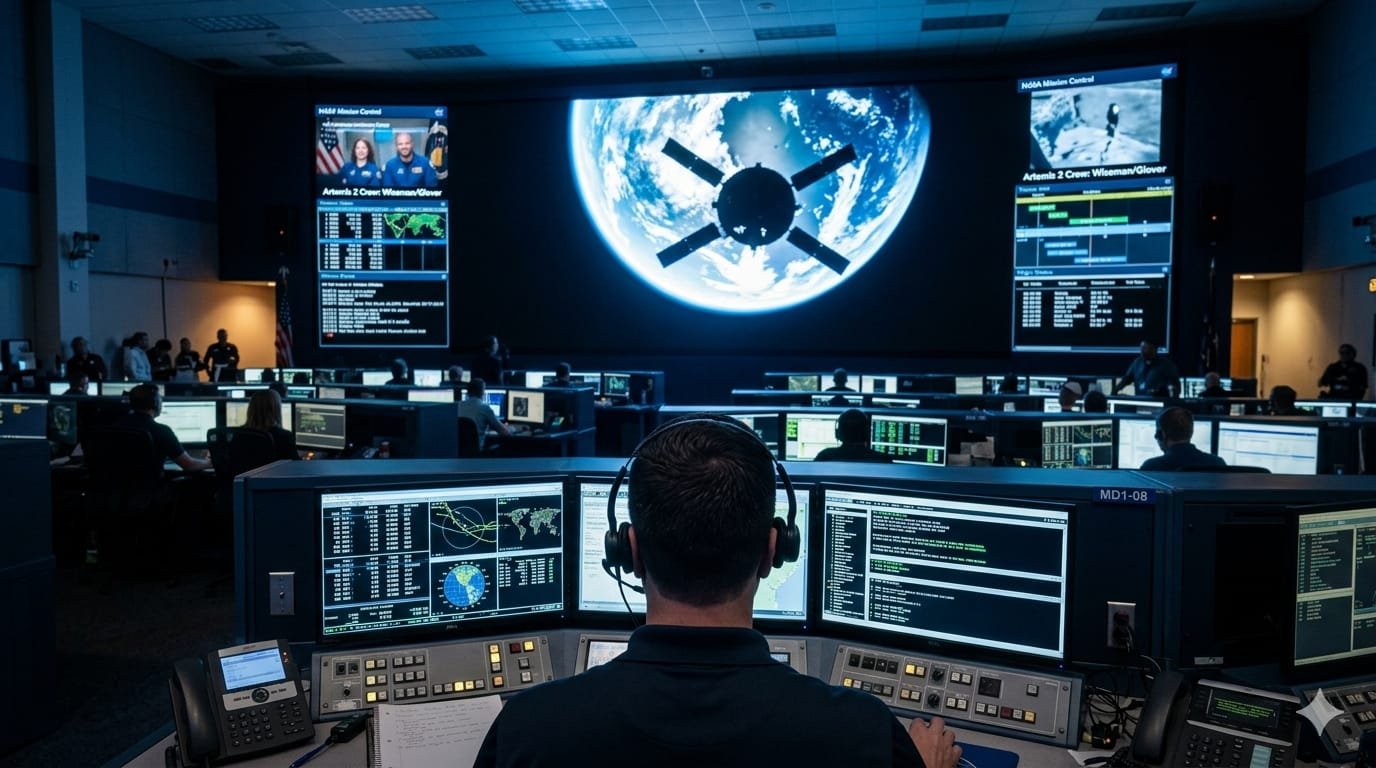
HOUSTON, TX — While global attention remains fixed on terrestrial conflicts, humanity reached a soaring milestone today. NASA’s Artemis II Moon Mission 2026 has successfully transmitted its first high-definition images of Earth from deep space, captured as the Orion spacecraft accelerates toward the lunar far side.
Key Highlights
- Deep Space Milestone: The Orion capsule has officially crossed the 200,000-mile mark from Earth.
- Historic Crew: The four-person crew includes the first woman, first person of color, and first Canadian (Jeremy Hansen) to leave Earth’s orbit.
- High-Tech Optics: New 8K camera systems have provided the clearest “Blue Marble” images in history.
- System Check: NASA confirms all life-support systems are nominal despite increased solar flare activity recorded earlier today.
A New Perspective for a New Generation
The images released by Mission Control in Houston at 11:14 AM EDT today offer a perspective not seen since the final Apollo mission in 1972. The Artemis II Moon Mission 2026 isn’t just a technical test; it is a cultural reset. The photos show a fragile, glowing Earth suspended in the absolute black of the void, a sight that Commander Reid Wiseman described over the comms as “humbled beyond words.”
These images serve a dual purpose. While they provide breathtaking content for the public, they are also vital for testing the optical navigation systems that will be used for the Artemis III landing mission scheduled for next year. Engineers are currently analyzing how the Orion’s shielding is holding up against the vacuum of space and the harsh light of the sun.
The Canadian Connection: Jeremy Hansen Makes History
Among the crew, Mission Specialist Jeremy Hansen has become a focal point of North American pride. Today, Hansen became the first Canadian to make a long-distance video call back to Earth from deep space. Speaking to students at a school in Ontario, Hansen showcased the “Candaarm3” technology integrated into the mission’s planning.
“We aren’t just here to look out the window,” Hansen told the students. “We are proving that international cooperation can reach the stars, even when things are difficult back home.” The success of Artemis II is being viewed as a necessary win for the international space community, demonstrating that the lunar gateway remains a top priority for the U.S. and its partners.
Technical Challenges: Solar Flares and Trajectory
The flight has not been without its “white-knuckle” moments. Early on April 4, NASA’s solar monitoring stations detected a mid-level solar flare. Fortunately, the Orion spacecraft is equipped with the most advanced radiation shielding ever flown on a crewed vessel.
The crew—Wiseman, Victor Glover, Christina Koch, and Hansen—executed a minor course correction burn today to ensure their free-return trajectory remains perfect. This maneuver ensures that even if the main engine were to fail later, the Moon’s gravity would naturally “slingshot” the capsule back toward Earth for a safe splashdown in the Pacific Ocean later this month.
Impact Analysis
- Scientific Progress: The data gathered during this flight is rewriting the manual on long-duration human spaceflight, specifically regarding how the human body reacts to deep-space radiation outside the Van Allen belts.
- Economic Inspiration: The “Artemis Generation” is already driving a surge in STEM enrollment across U.S. universities. Private space companies like SpaceX and Blue Origin are seeing record interest as the “Lunar Economy” begins to look like a reality rather than science fiction.
- National Unity: In a time of extreme political and military tension, the Artemis II mission remains one of the few topics that enjoys broad, bipartisan support in the United States, providing a rare moment of collective national achievement.