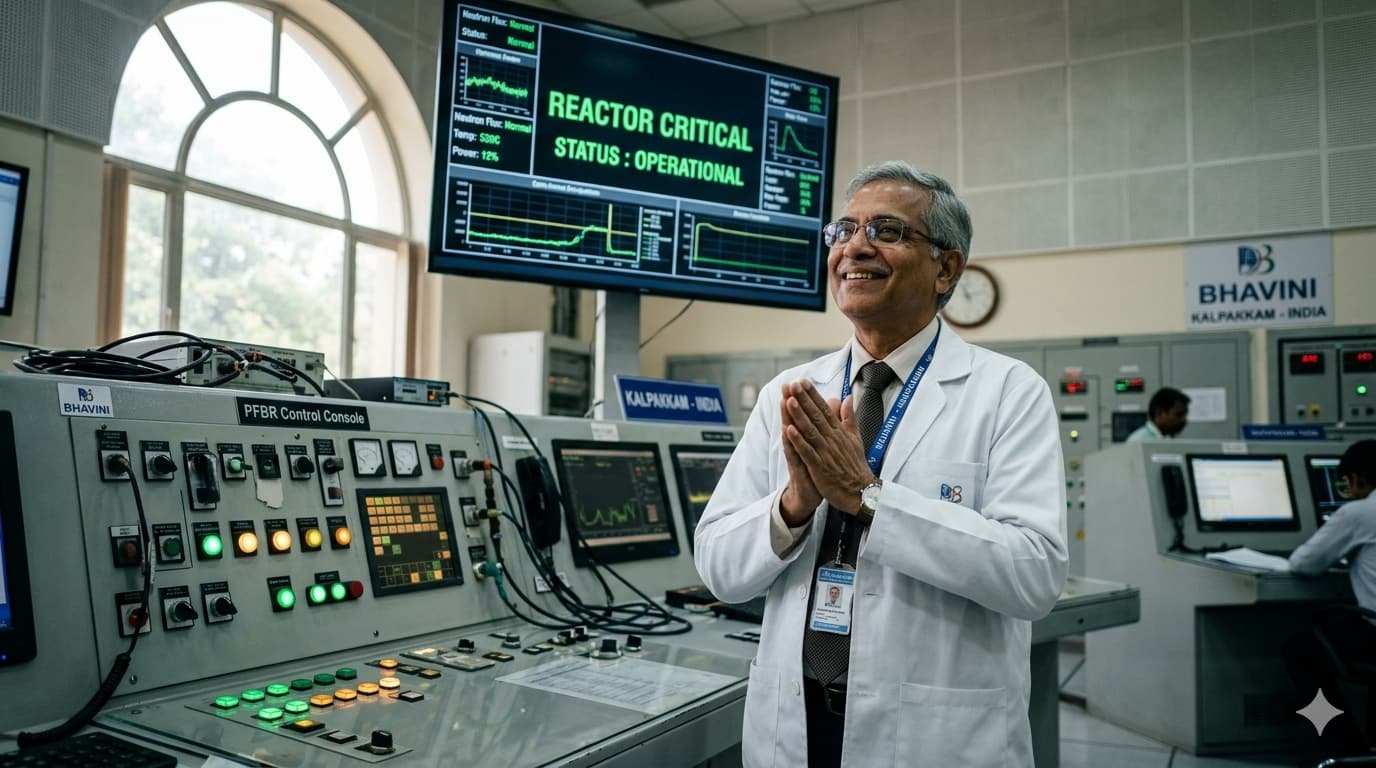
CHENNAI — India’s quest for long-term energy security reached a historic milestone today, April 7, 2026, as the indigenously developed Prototype Fast Breeder Reactor (PFBR) at Kalpakkam, Tamil Nadu, officially attained criticality. This technical breakthrough marks the successful initiation of a self-sustaining nuclear chain reaction, propelling India into an elite group of nations capable of commercializing advanced fast-reactor technology. Prime Minister Narendra Modi hailed the event as a “defining moment” for Atmanirbhar Bharat, signaling the nation’s transition into the second stage of its ambitious three-stage nuclear power program.
Key Highlights
- Strategic Milestone: The 500 MWe PFBR achieved criticality at 8:31 AM IST today.
- Global Standing: India becomes only the second country after Russia to possess a commercial-scale fast breeder reactor.
- Resource Efficiency: The reactor is designed to produce more fuel than it consumes by converting Uranium-238 into Plutonium.
- Clean Energy Push: A major step toward utilizing India’s vast thorium reserves for sustainable, carbon-free power.
The Science of Breeding: Producing More Than Consuming
The PFBR at Kalpakkam is not a conventional nuclear plant. Unlike traditional pressurized water reactors, the fast breeder utilizes high-energy “fast” neutrons to sustain the fission process. Its unique design allows it to “breed” new fissile material, effectively turning depleted uranium—often considered waste—into usable plutonium fuel.
This technological feat, developed by the Bharatiya Nabhikiya Vidyut Nigam Ltd (BHAVINI), is the linchpin of India’s nuclear strategy. By recycling spent fuel, the PFBR offers a solution to the global challenge of nuclear waste while significantly extending the life of India’s uranium resources. Experts suggest that the successful operation of this 500 MWe unit will pave the way for a series of twin fast-breeder reactors across the country.
Achieving Criticality Amid Global Energy Volatility
Today’s success comes at a crucial time as the ongoing conflict in West Asia continues to disrupt global energy markets. With crude oil prices fluctuating and international flight cancellations exceeding 10,000 due to regional airspace closures, India’s focus on energy sovereignty has never been more urgent.
The Kalpakkam milestone reduces India’s reliance on imported enriched uranium. Prime Minister Modi noted that the project involved over 200 Indian industries, including dozens of MSMEs, proving that the nation’s engineering enterprise can deliver world-class high-technology solutions independently of global supply chain tremors.
Unlocking the Thorium Vault for India’s Future
The ultimate goal of the “Stage II” fast breeder program is to create the conditions necessary for “Stage III”: the use of Thorium. India holds roughly 25% of the world’s thorium deposits, primarily in the monazite sands of its coastal regions.
By using the plutonium generated in fast breeders like the one at Kalpakkam, India will eventually be able to convert thorium into Uranium-233, providing a virtually inexhaustible source of clean energy for centuries. This roadmap is central to India’s commitment to achieving Net Zero emissions while meeting the surging electricity demands of its growing economy.
Impact Analysis
The criticality of the PFBR has immediate and long-term consequences for India’s geopolitical and economic standing:
- Energy Security: Provides a buffer against the price shocks of fossil fuels exacerbated by the West Asia crisis.
- Technological Export Potential: India now stands as a potential exporter of small and medium-sized fast reactor technology to the Global South.
- Environmental Goals: Accelerates the phase-out of coal-dependent power grids, directly contributing to India’s 2070 Net Zero target.