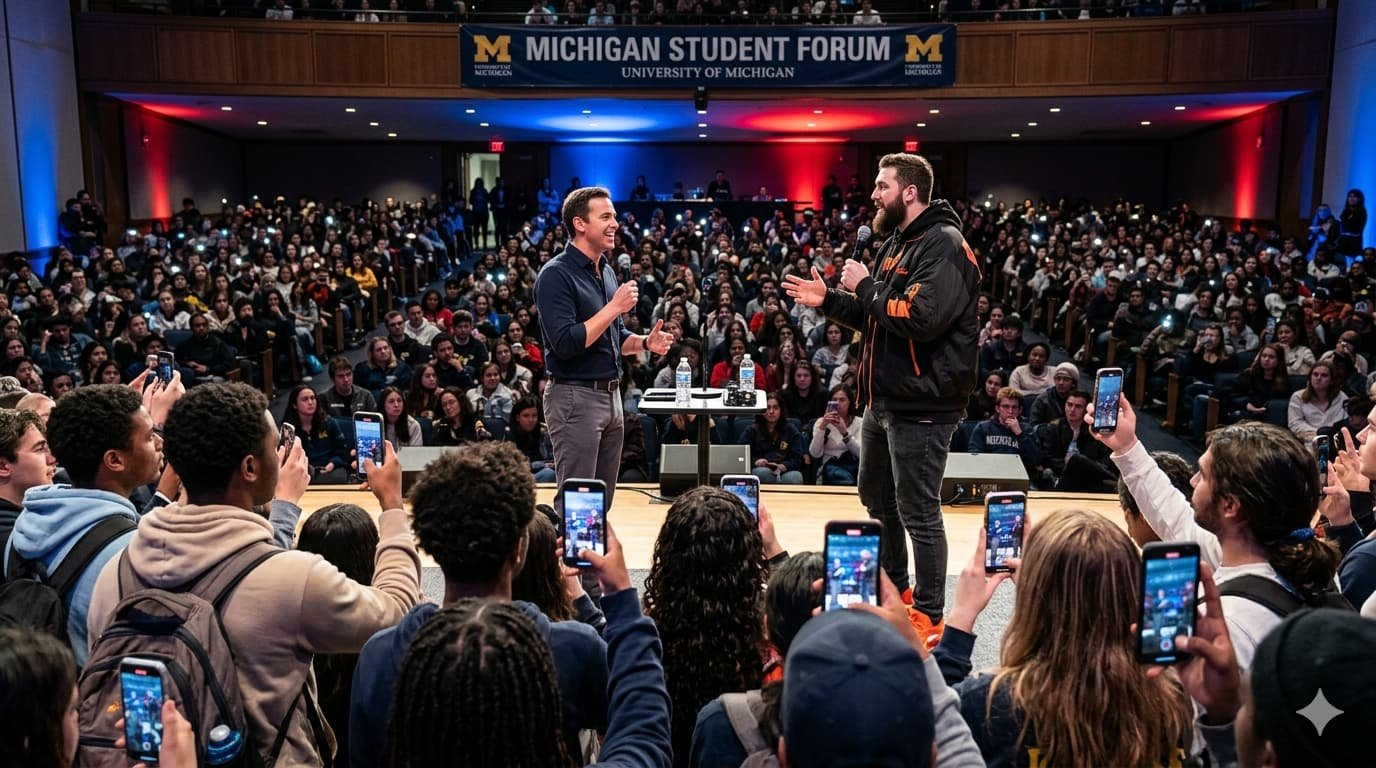
The intersection of digital fame and traditional politics reached a boiling point in Michigan this Tuesday as Hasan Piker, the polarizing Twitch titan, joined progressive Senate hopeful Abdul El-Sayed for a series of high-energy campus rallies. The events at Michigan State University and the University of Michigan were intended to bridge the gap between disillusioned young voters and the ballot box, but they have instead ignited a fierce debate over the Democratic Party’s “big tent” philosophy.
Piker, a 34-year-old Turkish American with a combined following of nearly 5 million across Twitch and YouTube, represents a new breed of political operative: the unscripted, populist influencer. While El-Sayed views Piker as a “megaphone” for a generation drifting toward the right or apathy, party moderates see a liability.
Key Highlights
- Strategic Gamble: Progressive candidate Abdul El-Sayed campaigns with Twitch streamer Hasan Piker to mobilize the youth vote in Michigan.
- Internal Friction: Moderate Democrats and opponents condemn the pairing, citing Piker’s past inflammatory rhetoric regarding 9/11 and the Israel-Hamas conflict.
- Media Shift: The collaboration highlights the Democratic Party’s increasing reliance on “new media” influencers to bypass traditional news cycles.
- High Stakes: The Michigan Senate primary serves as a proxy battle for the party’s soul ahead of a pivotal midterm election.
The Battle for the Youth Vote and Digital Influence
The decision to bring Piker onto the campaign trail is a calculated move by the El-Sayed camp to dominate the “attention economy.” In a shifting media landscape where traditional outlets are losing their gatekeeping power, Piker’s ability to engage young men—a demographic the Democratic Party has struggled to retain—is a potent tool.
During an interview with the Associated Press, Piker dismissed the controversy surrounding his past remarks as a distraction orchestrated by the “super-wealthy.” He framed his presence not as a fringe inclusion, but as a representative voice for a younger, more populist wing of the party that feels abandoned by the establishment. For El-Sayed, the risk of association is outweighed by the need to reach “unlikely and uncommon places” to build a winning coalition in a crowded primary against U.S. Rep. Haley Stevens and State Sen. Mallory McMorrow.
Controversy and the Shadow of Radical Rhetoric
The backlash from within the party has been swift and severe. Opponents have pointed to Piker’s history of “edgy” and often inflammatory commentary. Critics frequently cite his 2019 comment that “America deserved 9/11” (which he later clarified was a critique of U.S. foreign policy) and recent statements regarding the conflict in Gaza, where he once remarked that “Hamas is a thousand times better” than Israel.
State Sen. Mallory McMorrow and Rep. Haley Stevens have been vocal in their condemnation. McMorrow compared Piker’s influence to that of white supremacist Nick Fuentes, suggesting that Piker prioritizes “clicks and views” over constructive discourse. Meanwhile, Rep. Brad Schneider, chair of the New Democratic Coalition, labeled Piker an “unapologetic antisemite,” signaling a deep-seated rift between the party’s moderate pro-Israel wing and its emerging anti-war progressive faction.
Michigan’s Senate Primary as a National Litmus Test
The Michigan primary is more than a local race; it is a preview of the 2026 midterm strategy. The seat, being vacated by Sen. Gary Peters, is a “must-win” for Democrats hoping to maintain a foothold in the Rust Belt. The ideological divide among the candidates—ranging from Stevens’ “pro-Israel Democrat” stance to El-Sayed’s call to end military assistance to Israel—reflects a national identity crisis.
By aligning with Piker, El-Sayed is betting that the energy of the “online left” can be converted into physical votes. However, the move may alienate moderate suburban voters who are wary of the “extremes” often associated with internet subcultures.
Impact Analysis
- For the Democratic Party: This collaboration forces a confrontation over whether the party can tolerate radical rhetoric in exchange for youth engagement. If successful, “influencer campaigning” will become the standard. If it backfires, it may provide Republicans with easy ammunition to paint the entire party as “anti-American.”
- For Political Strategy: The move signals the end of the “press release era.” Candidates are now prioritizing interactive, unscripted livestreams over vetted town halls, sacrificing message control for authenticity.
- For the Michigan Electorate: The primary winner will face a tough general election against Republican Mike Rogers. The degree of party unity—or lack thereof—following this primary will likely determine if Michigan stays blue or flips red.