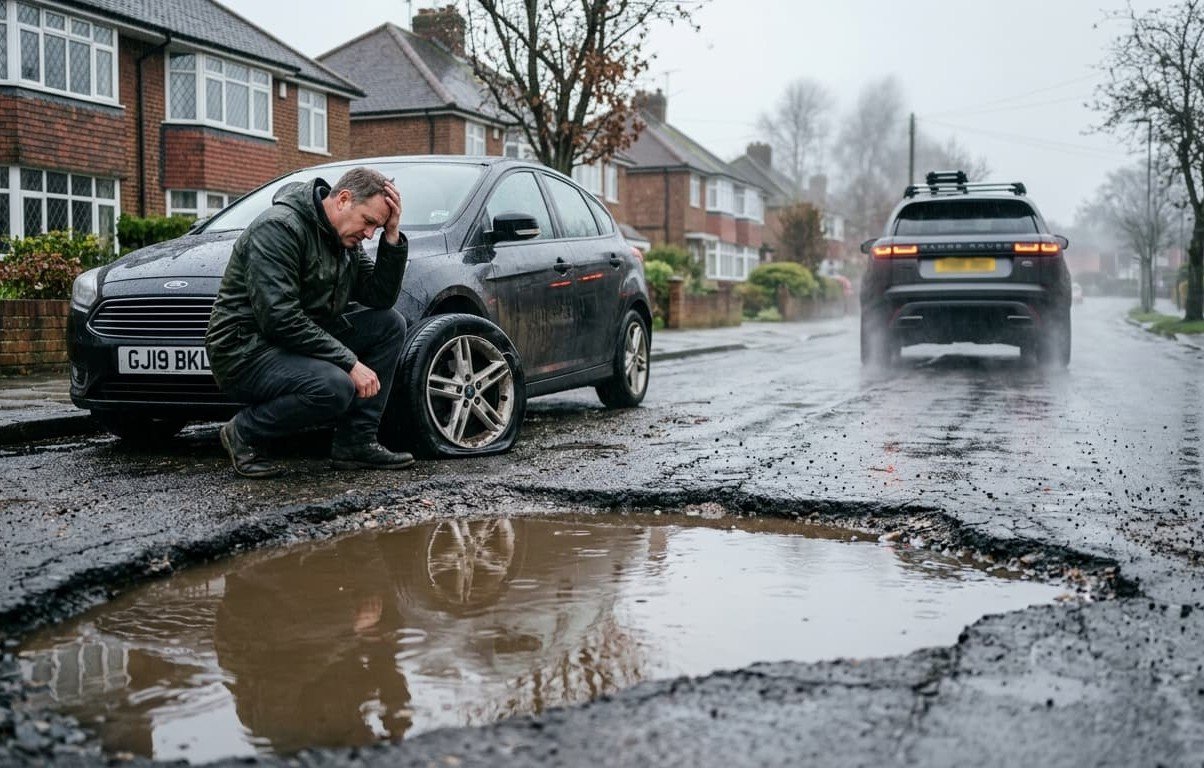
If you drove to work this morning, April 11, 2026, you likely spent more time eyeing the asphalt for craters than checking your mirrors. For many of us, the British commute has become a high-stakes obstacle course. But while we’re quick to blame the council for the state of our lanes, a growing chorus of engineers is pointing the finger at what’s sitting in our driveways, contributing to the UK pothole crisis.
A landmark study released today suggests that the “SUV-ification” of the UK—specifically the surge in heavy-set electric SUVs—is pushing our already fragile road network to a literal breaking point.
Addressing this issue is crucial to mitigate the ongoing UK pothole crisis as more drivers opt for heavier vehicles.
The Morning Briefing
- Heavy Toll: Modern electric SUVs are found to cause 30% more wear than the average family hatchback.
- The Cost of Living (and Driving): Pothole-related repairs are now the single biggest unforeseen expense for UK motorists this year.
- Empty Coffers: Local authorities are staring at a £14 billion repair backlog that isn’t going away.
- Westminster’s Next Move: Rumours of a “Tarmac Tax” based on vehicle weight are causing a stir in the Commons.
A heavyweight problem on a lightweight network
There’s a bit of a British irony at play here. We’re buying bigger, sturdier cars to feel safe and isolated from the bumps in the road, but the sheer physics of these vehicles is actually creating those very bumps.
Our local roads were largely designed for the era of the Morris Minor, not three-tonne electric “tanks.” When you combine the weight of modern battery packs with the sheer size of the SUV frame, the pressure on our aging Victorian-era foundations is immense. As one researcher put it this morning, “We’re trying to run a heavy-duty fleet on a light-duty legacy.”
The Manchester Mechanic’s View
Walk into any garage today and the story is the same. It’s not just about punctured tires anymore; it’s decimated alloys and snapped suspension springs. Mark Higgins, who’s been fixing cars in Manchester for twenty years, says he’s never seen anything like it.
“People come in fuming,” he tells me. “They pay a premium for a car that can ‘go anywhere,’ and then they hit a puddle on the A6 that’s deep enough to swallow a hubcap. You can’t blame them for being angry, but you also can’t ignore the fact that a car weighing as much as a small cottage is going to do some damage.”
Is a ‘Weight-Tax’ really the answer?
The political fallout is already starting to bubble. In Westminster, the “Tarmac Tax” is the phrase on everyone’s lips—a proposed levy that would charge drivers based on the weight of their vehicle. The idea is to use the funds to finally clear that £14 billion repair backlog.
Naturally, the motoring lobbies are already up in arms. They argue that this punishes those who have tried to “do the right thing” by switching to electric vehicles, which are inherently heavier due to their batteries. It’s a classic Catch-22 for the government: how do you encourage green driving without letting the roads crumble into dust in the process?
Impact Analysis
- The Commuter: Facing an “invisible tax” of repair bills and rising insurance premiums as insurers struggle with the cost of suspension claims.
- The Environment: A potential slowing of EV adoption if “weight-based” taxes make larger electric family cars too expensive to run.
- The High Street: Local businesses are feeling the pinch as customers avoid certain routes entirely due to road conditions, impacting footfall.