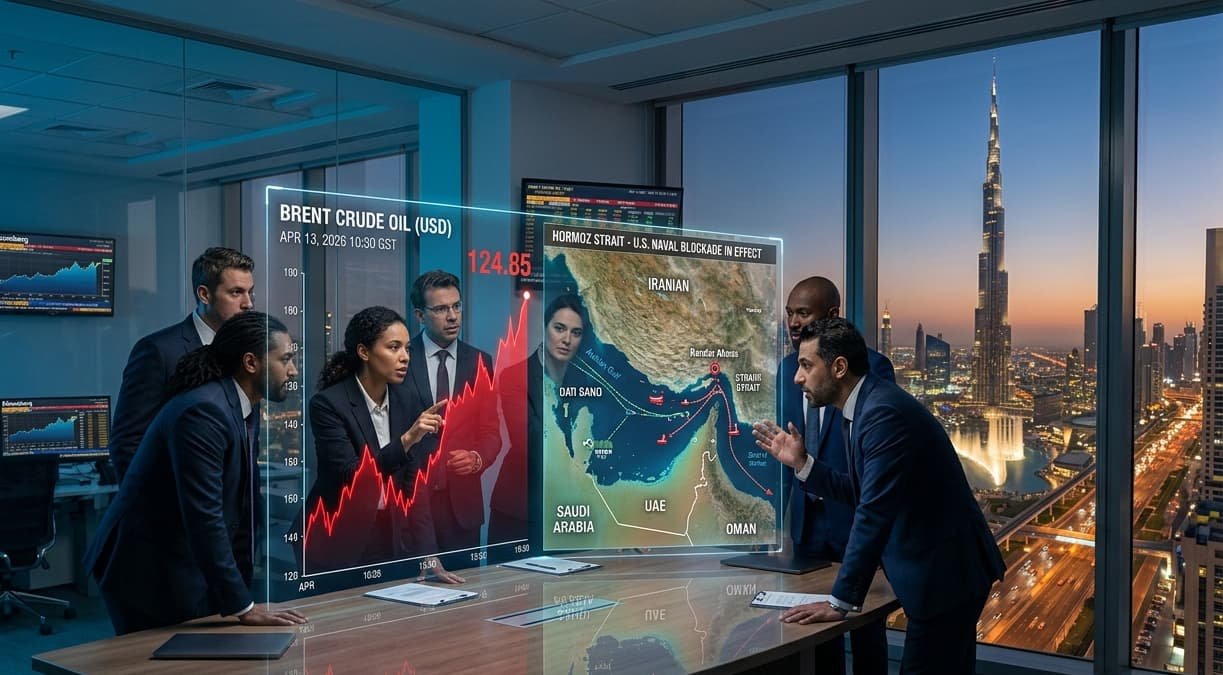
DUBAI: The calm of the Arabian Gulf has been replaced by the high-stakes chess of global geopolitics. As a journalist covering the pulse of this financial hub, the ground reality is palpable: we are witnessing what the IEA calls the “largest supply disruption in history.” Following the collapse of the 21-hour marathon talks in Islamabad between Washington and Tehran, President Trump has greenlit a naval blockade of Iranian ports.
Key Highlights
- Naval Blockade Begins: US CENTCOM to enforce a maritime blockade on all Iranian ports starting 10:00 AM ET (7:30 PM GST) today, following failed peace talks.
- Oil Supply Shock: Analysts warn of a “unprecedented disruption” as Brent Crude eyes the $125 mark; Riyadh and Abu Dhabi coordinate to ensure global market stability.
- Aviation Crisis: Major carriers, including Cathay Pacific, suspend Dubai and Riyadh services through June as jet fuel costs soar amid regional volatility.
- Riyadh’s Resilience: Despite the geopolitical storm, Saudi Arabia’s real estate sector remains buoyant with Alramz securing a $25M residential deal in the capital.
he big shift here is the clinical precision of the US announcement. While military vessels are being warned off, the Strait remains a narrow, high-tension corridor for non-Iranian civilian traffic. For the Gulf powerhouses, this is the ultimate test of economic diversification and strategic maturity.
The Oil Dilemma: Brent’s Bull Run Towards $125
In the trading floors of the DIFC, the mood is one of guarded aggression. Brent Crude is currently flirting with the $120–$125 range, a direct result of the “Hormuz Factor.” With Iran’s Revolutionary Guard claiming “full control” of the Strait, the risk premium on every barrel leaving the region has hit a decade-high.
However, Riyadh’s vision for a stable energy future remains the anchor. Saudi Arabia and the UAE have reportedly signaled their readiness to activate spare capacity, though the logistical nightmare of a maritime blockade makes “safe passage” the more critical keyword than “production volume.”
Aviation and Tourism: Navigating the ‘War Premium’
The “Gulf safety narrative” is under its toughest scrutiny yet. Cathay Pacific’s decision to cut passenger services to Dubai and Riyadh until the end of June highlights the soaring costs of jet fuel—which has spiked by nearly 13% in the last 48 hours.
But it’s not all retreat. While international transit is being re-routed, the internal engine of the Saudi economy is still firing. The announcement of a $25.1 million residential acquisition in Riyadh’s Al Malqa district by Al Ramz Real Estate proves that the long-term “Vision 2030” appetite for infrastructure remains undeterred by short-term skirmishes.
Gold and The Flight to Safety
As expected, gold is reclaiming its throne as the region’s preferred hedge. Local retail demand in Dubai’s Gold Souk has seen a 20% uptick as residents and investors move liquid assets into bullion. With the US Dollar Index strengthening, the dirham-pegged economy is feeling the dual pressure of a strong currency and rising commodity prices.
Expert Verdict
The Middle East is no longer just a spectator to global volatility; it is the arena. The US blockade is a gamble that aims to choke Iranian revenue but risks a global inflationary spiral that could force the IMF to rewrite its 2026 growth forecasts before the week is out.
Impact Analysis: The Global Ripple Effect
- Global Fuel Prices: Expect immediate “pain at the pump” across Asia and Europe as the 20% global supply through Hormuz remains under threat.
- Supply Chain Crisis: With 70% of the region’s food caloric intake passing through these waters, expect a “grocery emergency” in non-producing states.
- Investment Shift: Foreign Direct Investment (FDI) may temporarily pivot toward “hard assets” like Riyadh real estate or Dubai logistics hubs that are seen as shielded from direct combat.