CHENNAI/KOLKATA, April 23, 2026
Millions of Indians braved a blistering early-summer heatwave on Thursday to cast their ballots in a high-stakes electoral contest that marks a critical test for regional heavyweights and the national ruling party alike.
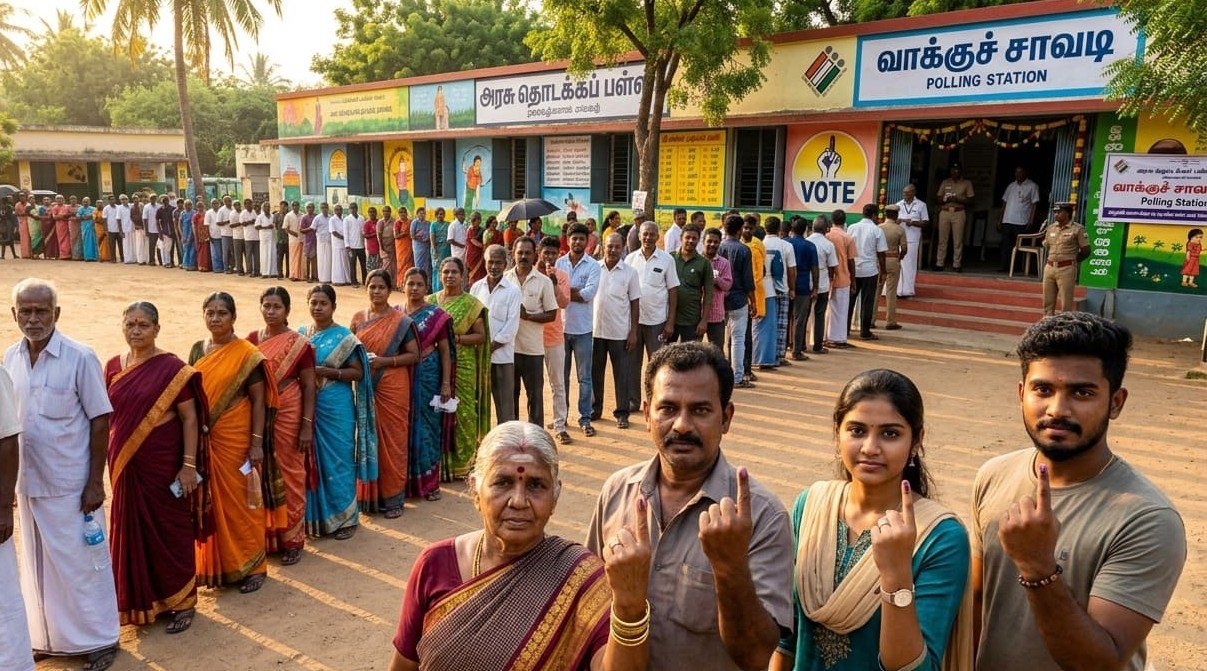
Polling opened early across all 234 assembly constituencies in Tamil Nadu and 152 seats in the opening phase of West Bengal’s staggered elections. The dual-state contest is being viewed by analysts as a barometer for the political climate ahead of national assessments. As temperatures soared above 40°C in several districts, voters lined up before dawn to exercise their franchise, demonstrating the resilience of the world’s largest democracy.
Key Highlights
- Massive Turnout: Over 9.3 crore (93 million) citizens are eligible to vote across both states despite an IMD Orange Alert.
- Southern Stronghold: CM MK Stalin’s ‘Dravidian Model’ faces its toughest challenge yet from a revitalized AIADMK-led NDA.
- Bengal Security: More than 2,400 companies of central security forces deployed to ensure a peaceful Phase 1 in West Bengal.
- Heat Protocols: For the first time, “Climate Booths” with medical teams and cooling fans have been deployed by the Election Commission.
Dravidian Identity vs. National Expansion in the South
In the southern industrial powerhouse of Tamil Nadu, the mood at the booths is one of quiet determination. Chief Minister MK Stalin, having centered his campaign on social justice and economic welfare, is facing a multi-pronged attack. While the DMK-led alliance highlights its infrastructure and education reforms, the opposition has focused its fire on administrative efficiency and local grievances.
A unique factor this time is the “Cinema-to-Politics” pipeline, with actor-politician Vijay’s newly formed outfit adding a “hero or cameo” intrigue to the triangular contest. “I voted for continuity and the protection of our regional rights,” said R. Kannan, 42, an auto-parts worker in Chennai. “We need a government that understands the specific industrial needs of the South.”
High-Stakes Security in Bengal’s Opening Salvo
Over 1,500 kilometers to the northeast, West Bengal is witnessing a different kind of intensity. The first phase covers 152 seats, a massive chunk that could dictate the momentum for subsequent phases. The Trinamool Congress (TMC) continues to lean on its “Ma, Mati, Manush” grassroots connect, while the BJP has shifted to a more “muted, door-to-door” strategy focusing on anti-incumbency and voter list concerns.
The Election Commission has left no stone unturned, deploying a record number of central armed police personnel to prevent the sporadic violence that has historically marred the state’s polls. So far, the morning has remained largely peaceful, barring minor scuffles reported from the Purba Medinipur district.
Economic Sentiment and Global Investor Interest
Foreign investors are closely monitoring the results in Tamil Nadu, a state that contributes nearly 10% to India’s GDP. Political stability in the region is seen as vital for the “Make in India” initiative, particularly in the semiconductor and EV sectors.
“The markets generally prefer policy stability in a manufacturing hub like Tamil Nadu,” said Sunita Rao, an equity analyst. “In Bengal, the focus is more on whether the political environment can transition toward a more industry-friendly landscape to match its neighboring states.”
Impact Analysis
The outcome of today’s polling will reverberate far beyond the borders of Chennai and Kolkata:
- Federal Power Balance: A strong showing for regional parties would embolden states demanding a higher share of central tax revenues and greater federal autonomy.
- Leadership Trajectory: For MK Stalin and Mamata Banerjee, today’s vote is about cementing their roles as primary anchors of a potential national alternative front.
- Climate Policy: The success (or failure) of the “Heatwave Protocols” during this election will likely set the standard for how India conducts public events in an era of rising temperatures.