CANBERRA, ACT — As the sun rises over Lake Burley Griffin this April morning, the weight of Australia’s most ambitious post-war alliance is becoming a physical reality. The AUKUS pact—the trilateral security architecture between Australia, the UK, and the US—has moved beyond the phase of political rhetoric and into the high-stakes world of heavy industry and advanced computation. For Australia, the “ripple effect” is no longer a distant theoretical; it is reshaping the nation’s suburbs, its shipyards, and its standing in the Indo-Pacific.
Key Highlights
- Adelaide Hub Reaches Milestone: South Australian shipyards confirm the first major structural completion of domestic SSN-AUKUS hull sections.
- Pillar II AI Integration: Canberra, London, and Washington launch “Project Cerberus,” a joint AI-driven maritime autonomous surveillance network.
- Regional Diplomacy: Australia’s Foreign Minister conducts a “Reassurance Tour” across ASEAN nations following China’s latest naval exercises.
- Economic Impact: Defense spending is projected to reach 2.4% of GDP by year-end, sparking a “Guns vs. Butter” debate in the federal budget.
The Industrial Awakening: Adelaide and Beyond
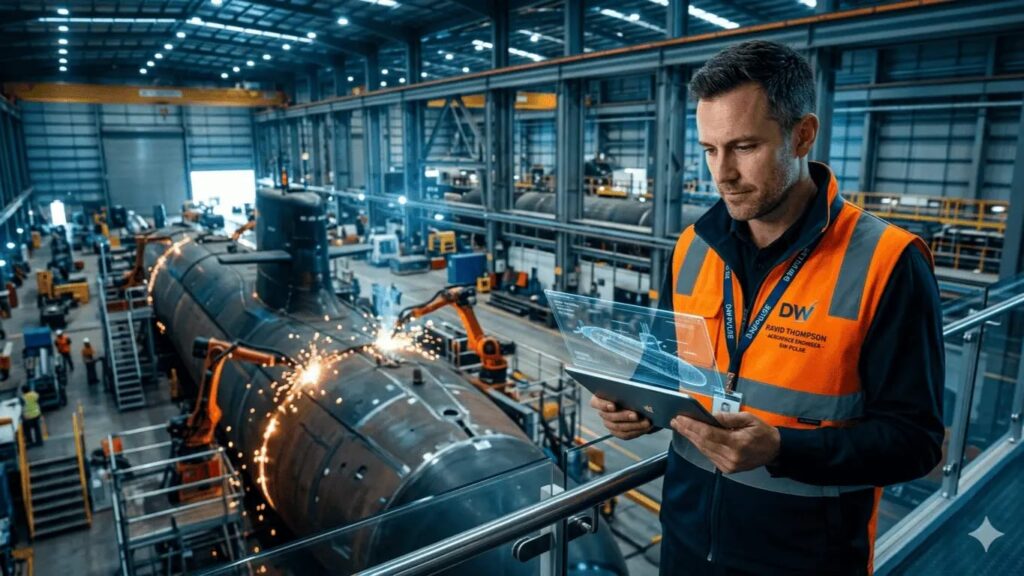
At the heart of the “AUKUS Ripple” is the transformation of Australia’s industrial landscape. As of April 5, 2026, the Osborne Naval Shipyard in South Australia has reported a critical milestone: the completion of the first major internal hull sections. This marks the transition of the Australian workforce into the elite “nuclear-capable” tier of global manufacturing.
However, the impact extends far beyond the steel. To support this fleet, a massive “knowledge economy” has emerged. Universities in Adelaide, Perth, and Brisbane have seen a record 25% surge in enrollments for nuclear engineering and advanced physics. The challenge for the government remains the “skills gap”—ensuring these highly specialized roles are filled by Australians rather than imported contractors.
Pillar II: The Silent Digital Shield
While submarines dominate the front pages, the most immediate ripple effect is felt in the digital realm. Today marks the official commencement of Project Cerberus, the first operational deployment of “Pillar II” technologies. This initiative integrates Australian-made undersea sensors with American AI and British quantum encryption.
This “Digital Ripple” is designed to create a “transparent ocean” across the Arafura and Coral Seas. By using autonomous underwater vehicles (AUVs) to monitor maritime chokepoints, Australia is significantly reducing its reliance on manned patrols. For the average citizen, this means a quieter but more potent defense posture.
The Diplomatic Tightrope in the Indo-Pacific
Geopolitically, the AUKUS ripple has created waves that have reached the shores of our closest neighbors. Following fresh naval drills by Beijing in the South China Sea earlier this week, Australian diplomats are working overtime to reassure Jakarta and Kuala Lumpur that AUKUS is a “stabilizer” rather than an “escalator.”
The economic ripple remains a double-edged sword. While AUKUS bolsters security, Australia remains economically tethered to China—its largest trading partner. The success of this strategy in 2026 will depend on whether Australia can convince the region that its new nuclear-powered teeth are purely defensive.