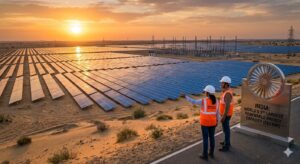
NEW DELHI / ABU DHABI – In a move set to redefine the geopolitical landscape of the Global South, India and the United Arab Emirates (UAE) officially signed the Comprehensive Energy and Infrastructure Corridor (CEIC) agreement today, April 10, 2026. The pact, finalized during External Affairs Minister S. Jaishankar’s visit to Abu Dhabi, establishes a multi-modal trade route designed to bypass traditional maritime chokepoints and secure India’s energy future amidst ongoing West Asia volatility.
Key Highlights
- Strategic Corridor: Launch of a direct energy-bridge linking Fujairah port to India’s Western Coast.
- LNG Security: A 20-year fixed-price Liquified Natural Gas (LNG) supply contract to insulate India from global price shocks.
- Digital Rupee Trade: For the first time, large-scale energy settlements will be piloted using the Digital Rupee (e₹) and the UAE’s Central Bank Digital Currency.
- Green Hydrogen: Joint investment of $15 billion into green hydrogen hubs in Gujarat and Rajasthan.
Bypassing Global Chokepoints: The Fujairah-Mumbai Link
As the U.S.-Iran conditional ceasefire enters its second day, the fragility of the Strait of Hormuz has become a primary concern for Indian policymakers. The CEIC agreement addresses this by prioritizing the development of the Fujairah port as a primary hub for Indian-bound shipments.
By utilizing the UAE’s coastline that opens directly into the Arabian Sea, India effectively secures a “Hormuz-bypass,” ensuring that even in the event of renewed regional hostilities, the flow of crude oil and gas remains uninterrupted. “This is not just a trade deal; it is a life insurance policy for our economy,” a senior official from the Ministry of External Affairs stated following the signing ceremony.
The Digital Rupee Revolution in Energy Trade
Perhaps the most disruptive element of today’s announcement is the shift in currency dynamics. India and the UAE have agreed to bypass the SWIFT system for a portion of their energy trade, opting instead for a blockchain-based settlement system.
This move toward de-dollarization in bilateral trade is expected to save Indian oil marketing companies (OMCs) billions in conversion fees and provide a hedge against U.S. dollar fluctuations. Market analysts suggest this could pave the way for other BRICS+ nations to adopt similar digital currency frameworks, further strengthening the “Deepening Strategic Partnership” between New Delhi and Abu Dhabi.
Powering ‘Viksit Bharat’: Green Hydrogen and Renewables
Beyond fossil fuels, the pact includes a massive $15 billion commitment to renewable energy. Following the recent success of the Prototype Fast Breeder Reactor at Kalpakkam, India is now looking to integrate nuclear-powered electrolysis with Emirati capital to become a global leader in green hydrogen production.
The agreement outlines the creation of “Green Corridors” where UAE-based Masdar and India’s NTPC will co-develop solar and wind farms. These projects are strategically aligned with India’s 2047 energy goals, aiming to provide low-cost power to the burgeoning semiconductor and EV manufacturing hubs in Western India.
Impact Analysis
| Sector | Short-Term Impact | Long-Term Outlook (2030+) |
| Energy Prices | Immediate stabilization of domestic LNG prices for fertilizers and power. | India becomes a net exporter of Green Hydrogen to Europe/Asia. |
| Finance & Fintech | Surge in Digital Rupee adoption for B2B transactions. | The Rupee gains “Hard Currency” status in West Asian markets. |
| Logistics | Increased investment in Mumbai and Kandla port infrastructure. | Fujairah-Mumbai becomes the world’s busiest energy transit lane. |
| Environment | Accelerated decommissioning of older coal plants. | Significant progress toward the 2070 Net Zero target. |