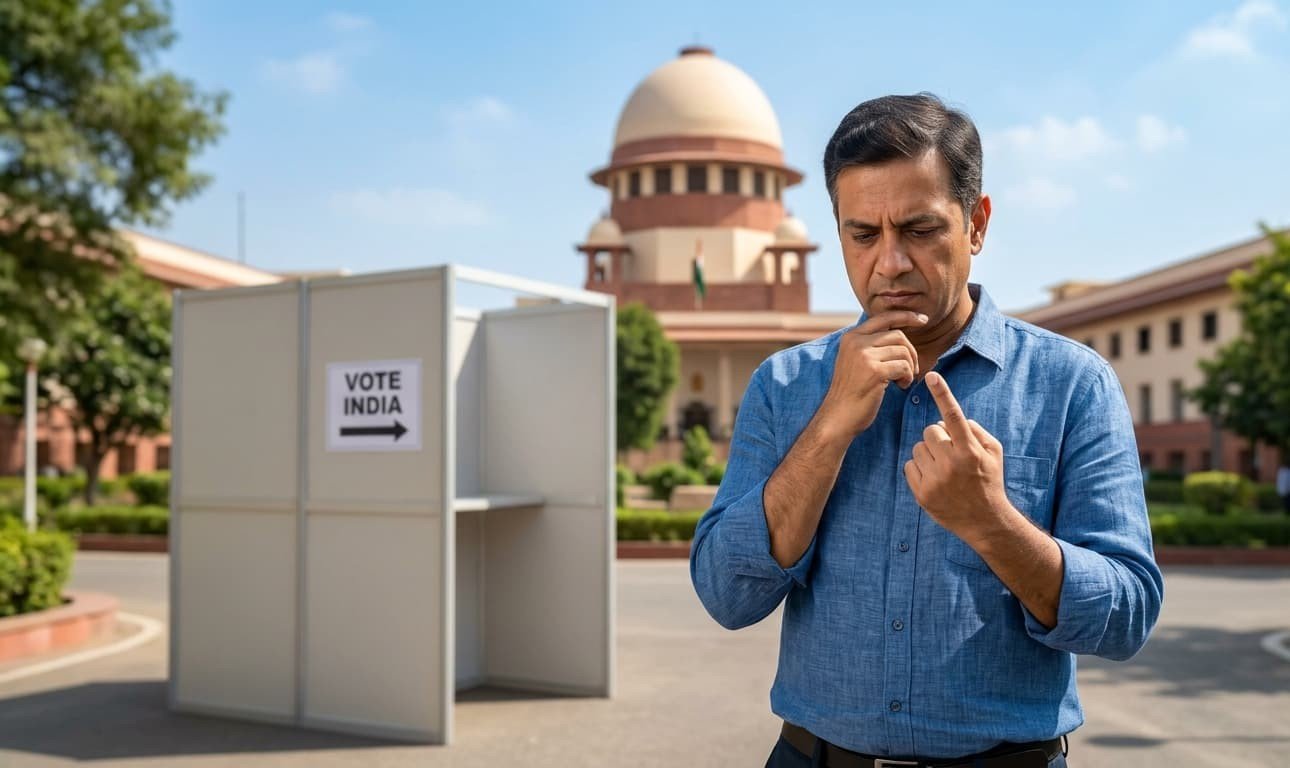
New Delhi, April 16, 2026 — In a landmark judgment that upholds the sanctity of individual liberty, the Supreme Court of India today ruled that citizens cannot be penalized, arrested, or “systemically shamed” for choosing not to vote. The Bench, headed by Chief Justice of India Surya Kant, clarified that while voting is a “pivotal civic duty,” it remains a voluntary right rather than a mandatory legal obligation. The ruling comes amidst growing chatter about the potential for “compulsory voting” laws to boost turnout in the upcoming 2029 General Elections.
Key Highlights
- Voluntary Participation: The SC reaffirms that voting is a “statutory right” with the freedom to abstain.
- No Punitive Action: Governments cannot withhold subsidies, benefits, or issue legal notices to non-voters.
- Moral vs. Legal: CJI Surya Kant emphasizes that democratic spirit cannot be “forced through the barrel of a law.”
- Voter Engagement: The court suggests “positive incentives” rather than “negative reinforcements” to increase turnout.
- Data Privacy: Election Commission warned against using AI-tracking to isolate or profile non-voters.
The Verdict: Liberty Over Compulsion
The decision was delivered in response to a Public Interest Litigation (PIL) that sought to implement a “voter accountability” system, where non-voters would face minor fines or temporary suspension of non-essential government digital services. The petitioner argued that low voter turnout weakens the democratic mandate.
Dismissing the plea, the Bench noted, “A vibrant democracy is built on the willing participation of its people, not on the fear of state-sponsored punishment.” The court observed that the Right to Vote inherently includes the Right to Refrain, much like the NOTA (None of the Above) option provides a voice to those dissatisfied with all candidates.
Addressing the “Compulsory Voting” Debate
For years, various political think-tanks have debated whether India should follow the footsteps of countries like Australia or Brazil, where voting is mandatory. Today’s ruling effectively shuts the door on such a legislative shift in India. The Court highlighted that in a country with significant migrant labor populations and socio-economic hurdles, mandatory voting would disproportionately punish the poor.
“A laborer who chooses to work a day’s shift to feed his family instead of standing in a four-hour queue cannot be treated as a criminal of the state,” Justice Joymalya Bagchi added during the proceedings. The ruling is seen as a massive victory for civil liberties advocates who feared that “Digital India” tools could be misused to track and penalize non-voters.
Positive Reinforcement vs. State Pressure
The Supreme Court did not entirely ignore the issue of low turnout. Instead, it directed the Election Commission (EC) to focus on Voter Education and Outreach (SVEEP). The Bench suggested that the government could explore “positive incentives”—such as small tax rebates or priority in certain administrative queues—to encourage voting, rather than using the stick of the law.
The EC has been asked to submit a roadmap within six months on how to make the voting process more accessible for senior citizens and differently-abled individuals, ensuring that “the choice to vote is an easy one to make.”
Impact Analysis
| Stakeholder | Potential Impact |
| Common Citizen | Protection from state harassment; no risk of losing welfare benefits over voting records. |
| Political Parties | Must work harder to “earn” the vote through better manifestos rather than relying on mandatory turnout. |
| Election Commission | Shift in focus from enforcement to engagement; need for better digital infrastructure for remote voting. |
| Legal Framework | Settles the long-standing debate on the constitutional nature of the “Right to Vote.” |