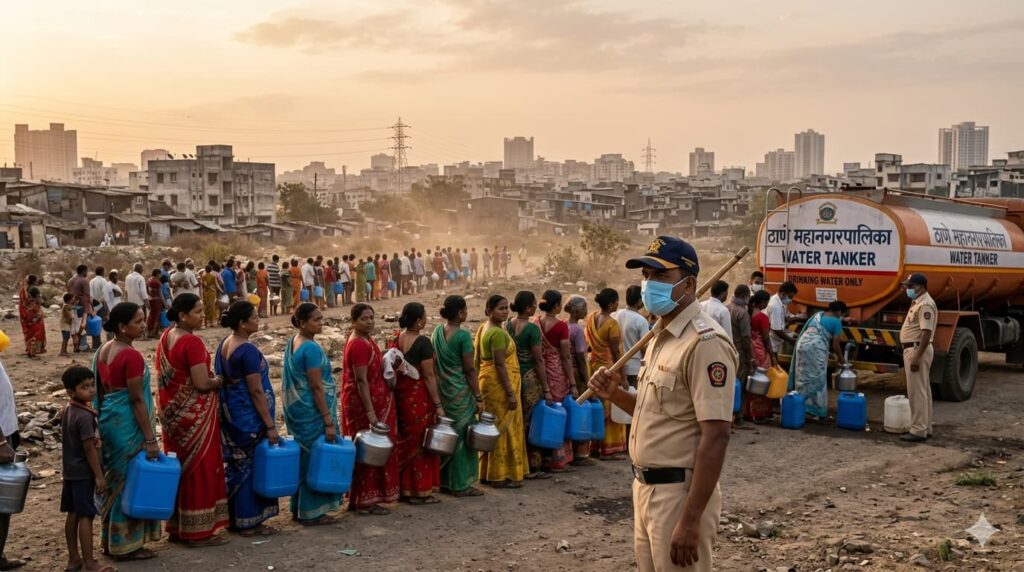
MUMBAI, MAHARASHTRA – In an unprecedented move highlighting the severity of the pre-monsoon water scarcity griping the state, the Thane District Administration today, April 5, 2026, imposed Section 144 of the Criminal Procedure Code (CrPC) around vital water filling points in Thane city and surrounding areas. The restrictive orders, usually reserved for political unrest, aim to prevent flare-ups and ensure the orderly distribution of water amidst an acute drought.
Key Highlights
- Emergency Measures: Thane administration enforces Section 144 Cr PC around key water filling stations and major pipelines.
- Preventative Action: Move is intended to avert clashes among residents queuing for water and prevent illegal tapping.
- Acute Scarcity: Pre-monsoon water stock in dams supplying the Mumbai Metropolitan Region (MMR) is at its lowest level in eight years.
- Water Rationing: Authorities consider further tightening water supply timings to urban households.
Thane Water Crisis: Section 144 Decoded
The decision to implement Section 144 CrPC, which prohibits the assembly of four or more people, was taken after several low-intensity skirmishes were reported at municipal water tanker filling points over the last 48 hours. District Collector Ashish Sharma stated that the police have been instructed to ensure peaceful and organized queuing for residents and authorized private water tankers.
“This is purely a preemptive measure to maintain law and order,” Sharma emphasized. “The current water situation has heightened tensions, and it is imperative we ensure equitable distribution without any disruptions or safety risks.” The order is effective immediately and will remain in place until the onset of the monsoon, subject to periodic review.
Heatwave Amplifies Maharashtra’s Water Woes
The current crisis has been severely exacerbated by an intense, prolonged heatwave sweeping across Maharashtra. Temperatures in several parts of the state, including the MMR and the neighboring Marathwada region, have consistently hovered 3-5 degrees Celsius above normal for this time of the year.
The soaring temperatures have accelerated the evaporation rate of the already depleted water resources in major dams. This climatic strain is putting unprecedented pressure on the state’s agricultural sector and urban supply systems, leading to water rationing and a heavy reliance on private water tankers.
Long-Term Water Management and Citizen Action
While the immediate focus is on crisis management through Section 144, urban planners are urging a re-evaluation of long-term water management strategies for the rapid expansion of the Mumbai Metropolitan Region. The crisis underscores the vulnerability of Maharashtra’s urban pockets to climatic variability.
Environmentalists are advocating for decentralized solutions, including mandatory rainwater harvesting and advanced wastewater recycling systems in all new residential and commercial complexes. “This is a loud wake-up call,” stated water conservationist Sunita Narain. “We must pivot away from a singular reliance on large dams and invest heavily in local-level water resilience and conservation education.” Public awareness campaigns are also being intensified to encourage water-saving practices among citizens.
Impact Analysis
| Category | Potential Impact |
| Social | Risk of increasing social friction and anxiety in affected areas due to scarcity and rationing. |
| Economic | Increased operational costs for businesses and industries requiring consistent water supply; potential impact on daily wage earners dependent on municipal water. |
| Public Health | Heightened risk of water-borne diseases if people resort to using unsafe water sources for daily needs. |
| Agriculture | While primarily urban, the underlying drought severely impacts crop yield in rural Maharashtra, driving food prices and migration. |