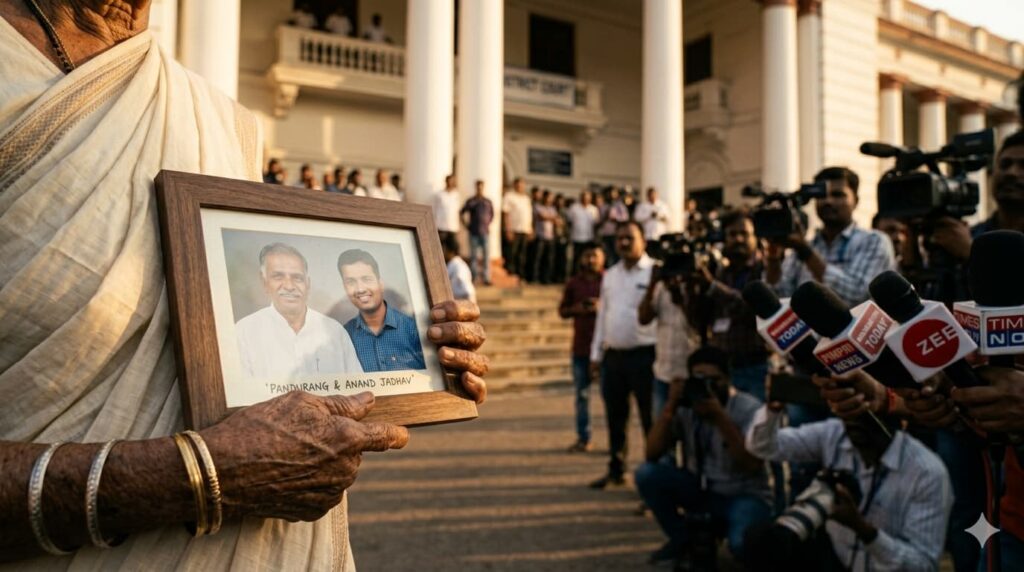
In a landmark judgment that has sent ripples across India’s legal and political landscape, the First Additional District and Sessions Court in Madurai today sentenced nine police personnel to death. The ruling concludes the harrowing 2020 Sattankulam custodial death case, involving the brutal demise of a father-son duo, P. Jayaraj and J. Benicks, while in police custody.
Key Highlights
- Verdict: All nine accused police personnel awarded the death penalty for the 2020 custodial murders.
- The Victims: P. Jayaraj (58) and his son J. Benicks (31) died following alleged torture at the Sattankulam police station.
- Judicial Precedent: Legal experts describe the “rarest of rare” classification as a stern warning against police brutality.
- Political Reaction: The ruling comes amidst high-decibel campaigning for the 2026 Tamil Nadu Assembly elections.
Landmark Verdict for Sattankulam Custodial Deaths
The Madurai court’s decision marks a definitive end to a six-year legal battle that began during the peak of the COVID-19 pandemic. On June 19, 2020, Jayaraj and Benicks were picked up for allegedly violating lockdown hours at their mobile shop. What followed was a series of events that horrified the nation: reports of extreme physical torture led to their deaths within days of each other.
The Central Bureau of Investigation (CBI), which took over the probe, presented a water-tight case involving forensic evidence and eye-witness accounts from within the station. Judge G. Moorthy, while pronouncing the sentence, noted that the nature of the crime—perpetrated by those sworn to protect the law—shook the “conscience of society.”
Impact of Justice on Tamil Nadu Assembly Elections
The timing of the verdict is significant as Tamil Nadu prepares for its upcoming Assembly elections. Today, April 6, 2026, also marked the deadline for filing nominations in several constituencies. Political leaders across the spectrum have been quick to react.
Chief Minister M.K. Stalin hailed the verdict as a “victory for human rights,” while opposition leaders have used the moment to highlight the need for systemic police reforms. The case has become a focal point for voters demanding accountability and the implementation of the long-pending Prakash Singh directives on police autonomy and reform.
Strengthening Human Rights and Police Accountability
Beyond the immediate sentencing, this case serves as a judicial lighthouse for human rights in India. For decades, custodial torture has been a systemic shadow over the Indian police force. By awarding the maximum punishment, the Madurai court has reinforced the principle that “uniformed criminals” will face the same, if not harsher, scrutiny as any other citizen.
Activists are now calling for the immediate ratification of the UN Convention Against Torture, arguing that while the Madurai verdict provides closure, the prevention of such incidents requires legislative teeth.
Impact Analysis
| Sector | Short-term Impact | Long-term Impact |
| Legal | Immediate morale boost for human rights litigators and victim families. | Sets a high bar for the “rarest of rare” doctrine in cases of State-sponsored violence. |
| Political | Becomes a key campaign talking point regarding law and order and state oversight. | Potential for legislative shifts toward mandatory judicial inquiries for all custodial deaths. |
| Social | Massive public discourse on social media regarding police reform and civil liberties. | Increased public scrutiny and reduced tolerance for “minor” police excesses. |