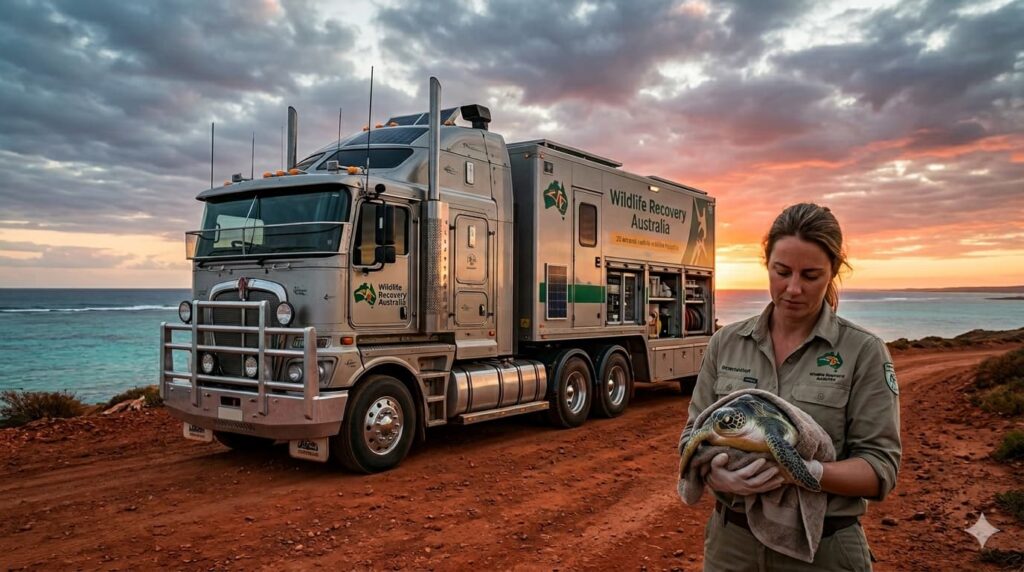
EXMOUTH, WA – In a remarkable cross-continental journey, Australia’s premier mobile wildlife hospital, affectionately known as ‘Matilda,’ has arrived on Western Australia’s Coral Coast to spearhead a massive rescue operation. Having departed her home in New South Wales’ Ballina Shire on March 3, the 22-wheel behemoth was redirected from a national advocacy tour to provide urgent medical aid to wildlife devastated by the remnants of Tropical Cyclone Narelle.
Key Highlights
- Coast-to-Coast Dash: Matilda, Australia’s only 22-wheel mobile wildlife hospital, has crossed from Lennox Head to the Coral Coast.
- Disaster Response: The facility is now stationed in Exmouth to treat animals injured by Category 3 Tropical Cyclone Narelle.
- Species at Risk: Early reports confirm successful triaging of washed-up dolphins, sea turtle hatchlings, and various seabirds.
- National Significance: The mission highlights the increasing vulnerability of native fauna to extreme weather events in 2026.
The deployment marks one of the most significant logistical feats in Australian wildlife conservation history. As the Category 3 storm battered the coastline, local rescuers were overwhelmed by the sheer volume of injured animals. Matilda’s arrival in Exmouth provides a state-of-the-art surgical suite and triage center directly at the heart of the disaster zone.
The Wildlife Toll of Cyclone NarelleThe impact of the cyclone has been described by local experts as “distressing.” The combination of high-velocity winds and storm surges has displaced thousands of animals, many of which require specialized veterinary care that local clinics simply cannot provide at scale.Dr. Stephen Van Mil, Founder and CEO of Wildlife Recovery Australia, stated that the scale of the crisis made immediate intervention a necessity. “This natural disaster has shown in distressing detail how vulnerable wildlife is to increasingly frequent and violent weather events,” Dr. Van Mil remarked. Currently, the hospital is treating a variety of marine and terrestrial species, including juvenile dolphins found washed ashore and hundreds of sea turtle hatchlings that were swept from their nests.A Tech-Forward Sanctuary on WheelsMatilda is not merely a transport vehicle; it is a high-tech medical hub. Equipped with digital X-ray machines, ultrasound technology, and a dedicated operating theatre, the mobile hospital allows veterinarians to perform life-saving surgeries on-site. This significantly reduces the stress on injured animals that would otherwise face hours of transport to permanent facilities in Perth or Broome.The 2026 mission also serves as a critical data-gathering exercise. Scientists on board are documenting the specific types of injuries sustained during the cyclone to better understand how to protect vulnerable populations as climate-driven weather events become more severe across the Australian continent.