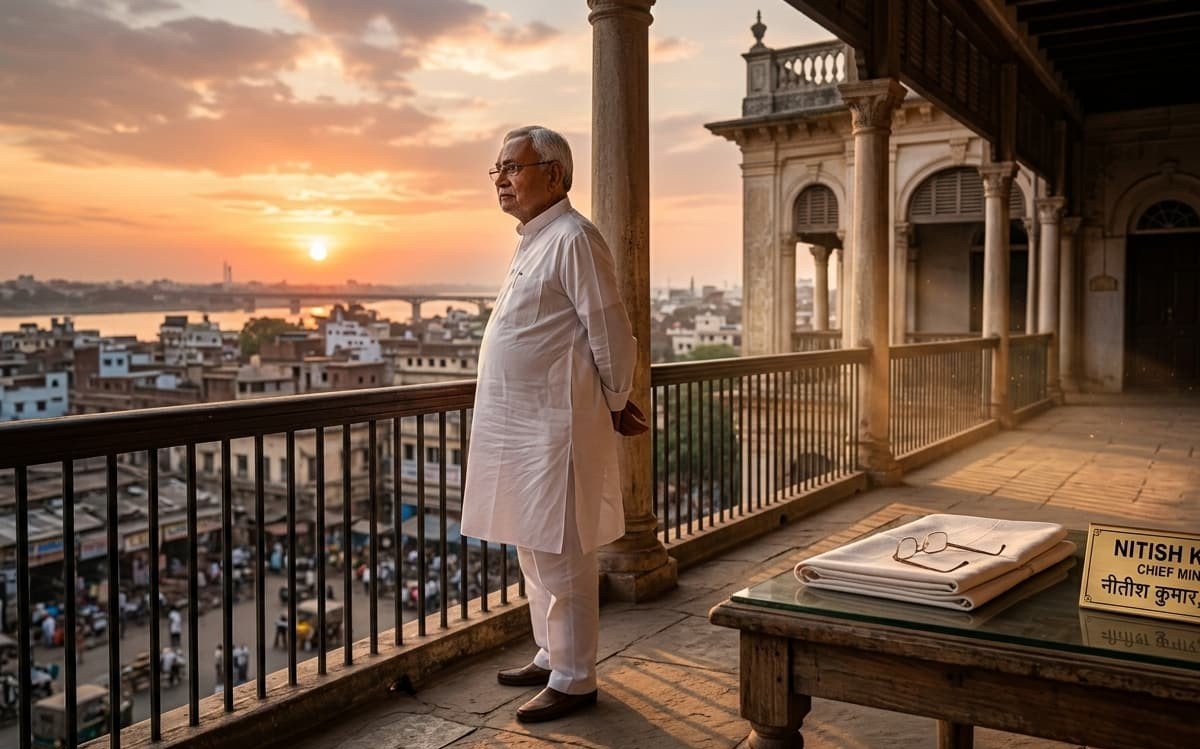
PATNA: The shifting sands of Bihar politics are once again the talk of every nukkad and chai ki tapri across the state. In what appears to be the most significant power transition in recent years, Chief Minister Nitish Kumar is widely expected to tender his resignation on Monday, April 13, 2026.
The veteran leader, who has dominated the Bihar landscape for two decades, recently took oath as a Rajya Sabha member on April 10. This move effectively signals the end of his record-breaking tenure as Chief Minister and his shift toward a national role in Delhi.
Key Highlights
- Departure Timeline: Nitish Kumar is expected to chair his final Cabinet meeting on April 13 before heading to the Raj Bhavan to resign.
- New Role: Having taken oath as a Rajya Sabha member yesterday, Kumar is paving the way for a fresh face to lead the NDA in Bihar.
- Furniture Shift: Sources at 1, Anne Marg report that the CM has already begun moving his personal belongings to his private residence at 7, Circular Road.
- BJP’s Turn: Rumors suggest the next Chief Minister will be from the BJP, with Deputy CM Samrat Choudhary emerging as a top contender.
- Opposition Moves: The ‘Grand Alliance’ (Mahagathbandhan) is scheduled to meet on April 12 to strategize against the upcoming leadership change.
End of the ‘Sushasan Babu’ Era
For over twenty years, Nitish Kumar has been the “X-factor” of Bihar. Known as ‘Sushasan Babu’ (Man of Good Governance) for his early work on infrastructure and girls’ education, his departure marks the end of a long, often unpredictable chapter. Having served ten terms as CM, his decision to move to the Rajya Sabha isn’t just a career shift; it is a seismic event for the JD(U).
The atmosphere at the JD(U) headquarters is a mix of nostalgia and uncertainty. Senior leaders met at the CM’s residence today for a two-hour marathon session. While the official line remains “routine discussion,” the focus was clearly on the transition of power and the future of the party without its primary face at the helm in Patna.
The Delhi Calling: Transition to National Politics
Nitish Kumar’s entry into the Upper House, administered by Vice President C.P. Radhakrishnan, indicates that the NDA wants to utilize his vast administrative experience at the Center. By stepping down now, Kumar allows the BJP—the larger partner in the current coalition—to take the driver’s seat ahead of the next electoral cycle.
Political analysts suggest this is a calculated move. “Nitish ji knows the ground is shifting,” says a local political commentator. “By moving to Delhi, he preserves his legacy while allowing the BJP to test its own leadership in Bihar before the 2029 general elections.”
Who Will Wear the Crown Next?
As Nitish Kumar packs his bags, the million-rupee question remains: Who is next? The BJP camp is buzzing with activity. With the party likely to claim the CM post, Samrat Choudhary, a prominent leader from the Kushwaha community, is the frontrunner. However, the party might pull a surprise by elevating an EBC (Extremely Backward Class) leader to solidify its “silent” voter base. Meanwhile, within the JD(U), there is growing chatter about Nitish’s son, Nishant Kumar, potentially taking up a leadership role to keep the party’s core together.
Impact Analysis
- Political Stability: While the NDA holds a majority, a change in leadership often leads to internal friction. The BJP will have to balance the egos of senior JD(U) leaders who have only ever known Nitish as their boss.
- Caste Dynamics: The transition is happening just as the Grand Alliance organizes a massive rally of the ‘Pan’ (Betel) community. Any perceived slight to backward caste representation in the new Cabinet could be exploited by Tejashwi Yadav and Rahul Gandhi.
- Administrative Continuity: Bihar has been synonymous with Nitish’s “Seven Resolves” (Saat Nischay). A new CM may bring a different set of priorities, potentially slowing down ongoing projects during the hand-off.