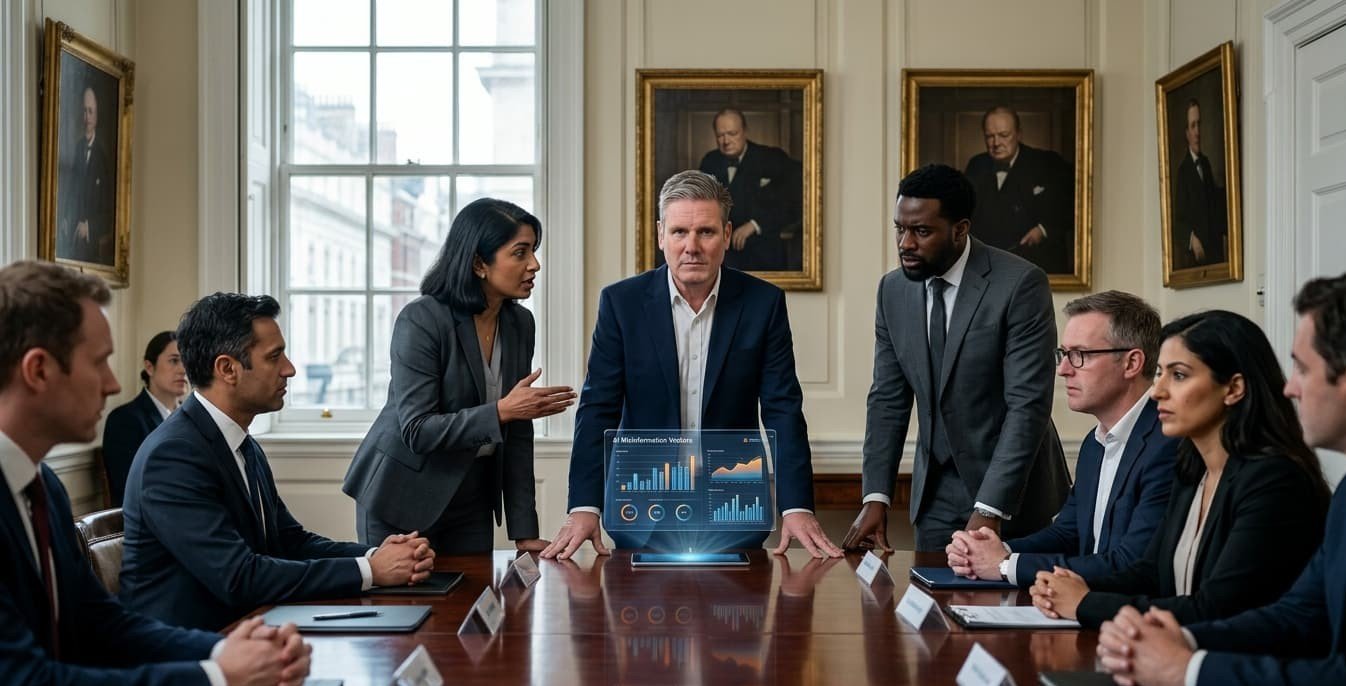
LONDON – In a high-stakes showdown at Number 10 today, the Prime Minister issued a blistering ultimatum to the world’s most powerful tech executives, declaring that the era of “digital lawlessness” must end. As the UK grapples with a surge in sophisticated AI-generated misinformation and a precarious economic outlook, the government is moving to tighten the noose around social media platforms that fail to police harmful content.
Standing on the steps of Downing Street following the summit, the Prime Minister was uncharacteristically blunt. “For too long, these platforms have treated the British public as a data set rather than a community,” he said. “With the rise of deep-fake technology, the risk to our social fabric is no longer theoretical—it is an active threat.”
| Key Highlights |
| PM Keir Starmer hosts emergency Downing Street summit with Meta, Google, X, and TikTok. |
| New Directives: Social media firms warned that “looking the other way is no longer an option” regarding AI-generated misinformation. |
| IMF Warnings: Economic growth forecasts for the UK slashed to 0.8% as geopolitical tensions and energy spikes bite. |
| Industry Pushback: Tech leaders cite “infrastructure gaps” as a barrier to real-time content moderation. |
The AI Frontier: Security vs. Silicon Valley
The meeting, attended by senior leadership from Meta, Snap, Google, TikTok, and X, focused on the rapid proliferation of “agentic AI”—autonomous bots capable of generating and spreading hyper-realistic fake news. Government sources suggest that the Home Office has seen a 40% increase in AI-driven fraud and disinformation campaigns since the start of the year.
The tech giants, however, have pointed to the sheer scale of the problem. A representative from the techUK trade body noted that while AI is the “engine of growth,” the UK’s current infrastructure is struggling to keep pace with the processing power required for real-time, automated moderation. “We are in a race between the arsonists and the fire brigade,” one executive reportedly told the Cabinet.
Economic Headwinds: A Resilient but Fragile Recovery
The summit comes at a time of significant economic anxiety. While fresh data from the Office for National Statistics (ONS) showed that the UK economy was surprisingly resilient in February, the International Monetary Fund (IMF) has delivered a sobering reality check.
This week, the IMF slashed the UK’s 2026 growth forecast from 1.3% to a meagre 0.8%. This is the most severe downgrade in the developed world, largely attributed to the UK’s exposure to the ongoing conflict in the Middle East. As a major energy importer, Britain is feeling the pinch of spiking oil prices and “weakly anchored” inflation expectations. For the average Briton, this translates to a continued squeeze on living standards and a “soft” labour market, particularly for those under 25.
The Digital Sovereignty Debate
Critics of the government’s approach argue that heavy-handed regulation could stifle the very innovation needed to pull the UK out of its economic slump. Industry leaders at the “UK Flag Forum” held in London today argued that the government should focus on “fiscal reform and energy costs” rather than restrictive digital policing.
However, the mood in Westminster has shifted. There is a growing consensus that the “move fast and break things” mantra of the last decade is no longer compatible with national security. The PM’s message today was a clear signal: the UK intends to lead the world in AI safety, even if it means bruising a few egos in Silicon Valley.
Impact Analysis
- Social Impact: A potential crackdown on social media could lead to stricter age verification and “truth-tagging” on AI content, fundamentally changing how Brits consume news.
- Economic Impact: The IMF downgrade suggests a “mild recession” remains a distinct possibility. Businesses may see a contraction in investment as the Bank of England weighs interest rate cuts against a potential inflation spike.
- Political Impact: By taking a hard line on “Big Tech,” the government is attempting to project strength and stability amidst global chaos, hoping to shore up public trust ahead of local elections.