Leaning against a wall near a news-stand in central Rome, Tommaso Silvestri, 65, slowly scans the morning’s front pages. The headlines say it all — “apocalypse,” “scandal,” “disaster” — after Italy’s latest and most damning footballing collapse.
“We’ve made a real mess of it,” he says, shaking his head. “We had players who couldn’t even find the target. The golden days of Italian football are well and truly gone.”
On Tuesday night in Zenica, four-time World Cup champions Italy missed out on a third consecutive tournament, losing 4-1 on penalties to Bosnia and Herzegovina after being reduced to ten men before halftime.
A front-page editorial in the Gazzetta dello Sport captured the national mood, labeling the defeat “The third apocalypse” and noting that the sense of shock has faded — it is fast becoming the norm.
The first absence in 2018 was written off as a fluke. The second in 2022 was treated as a crisis. Now, failing to qualify has become almost expected for the once-proud soccer nation.
Back on the streets of Rome, the disbelief is palpable. “We are what our results say we are,” Silvestri said. “When you shoot and can’t even hit the goal, you’re not going to go far. When it comes to taking the game home, Italy just doesn’t get there anymore.”
The players shared that anguish. “It’s upsetting for everyone — for us, for our families, and for all the kids who have never seen Italy at a World Cup,” said a tearful Leonardo Spinazzola.
For a country that has produced legends like Baggio, Paolo Maldini and Gianluigi Buffon, the idea that Italy is no longer competitive on the world’s biggest stage is almost unthinkable.
The rot, many argue, goes far beyond the pitch. Italy’s top coaches have shown little desire for the national job, Serie A clubs consistently refuse to reschedule fixtures to give Azzurri players adequate rest before international matches, and the federation has failed to enforce meaningful structural reform.
Former Prime Minister Matteo Renzi called it “a sign that Italian soccer has failed,” warning that football is not merely entertainment in Italy but a cornerstone of national identity.
Italy will now go at least 16 years without appearing at a World Cup — an entire generation of players and fans for whom the tournament remains a distant memory.
For Silvestri, staring at the headlines outside a Roman news-stand, the reckoning feels long overdue. “We used to be feared,” he says quietly. “Now? Nobody is afraid of Italy anymore.”
Home
Italy’s World Cup Nightmare Deepens: Fans React to ‘Third Apocalypse’ After Bosnia Defeat
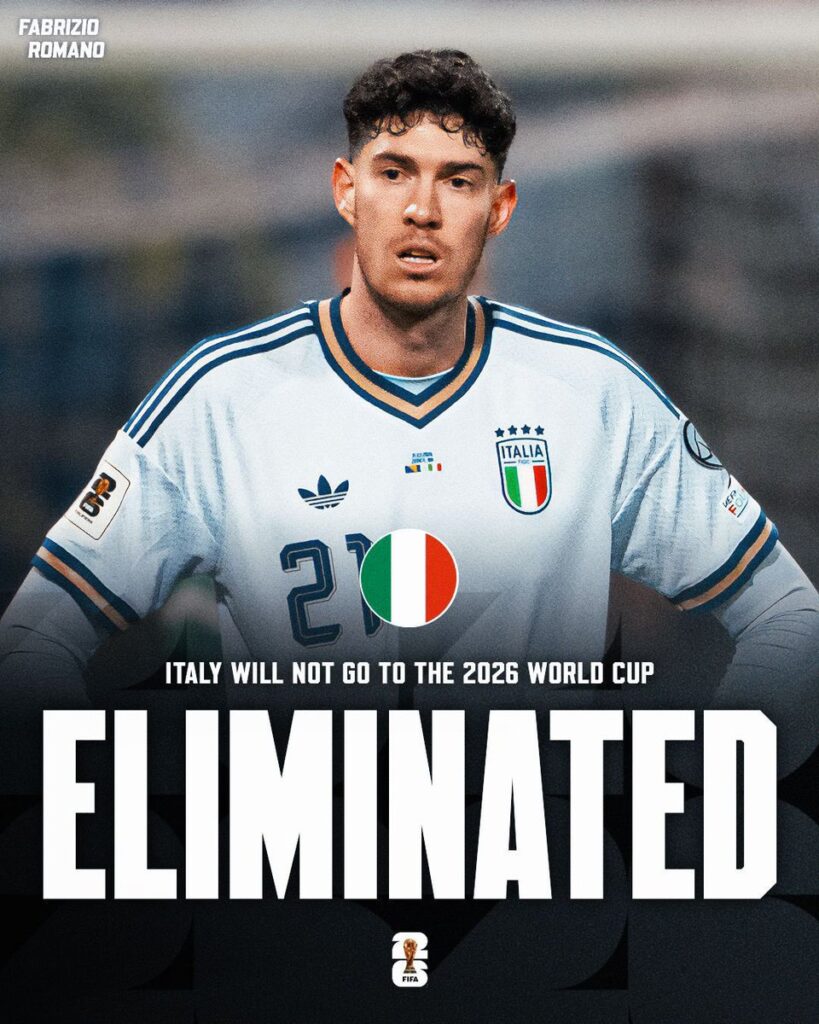
Italy’s World Cup Nightmare Deepens: Fans React to ‘Third Apocalypse’ After Bosnia Defeat | Photo: DW Pulse
Related News